Showing posts with label assignments. Show all posts

Monday, October 22, 2018

Friday, October 5, 2018

Cromwell - Hero or Villain?

Please watch the video and take notes to prepare for the Oliver Cromwell obituary.  

Was he a Hero?  Or a Villain?


Monday, October 1, 2018

Reading on the Civil War

Please read the first two paragraphs of this article and answer the questions below.  (Due Tuesday, October 2nd [blocks 2 and 7] or Wednesday, October 3rd [block 5])


You only need to read the first TWO PARAGRAPHS of the article.

1.  Why is the English Civil War so complicated, according to the article?

2.  The article goes on to say that, even if “the enemy” was defeated, “peace” was hard to come by.  Why?

3.  What was the primary conflict in England?
4.  What were some of the possible things that Parliament wanted if they won the war?
5.  Lots of different people had lots of different interests during the English Civil War.  Please explain what each of the following wanted:
The Scots:

The Irish:

The Aristocracy:

the “newly wealthy:”

the Puritians:


Tuesday, May 12, 2015

Homework chart - 5/13/15

Here is a link to the chart that should accompany your reading for pages 607-612.  Please print it out and fill it in.

This will be due on Thursday, 5/14 instead of Wednesday 5/13, so you should have plenty of time to complete it.


Tuesday, March 3, 2015

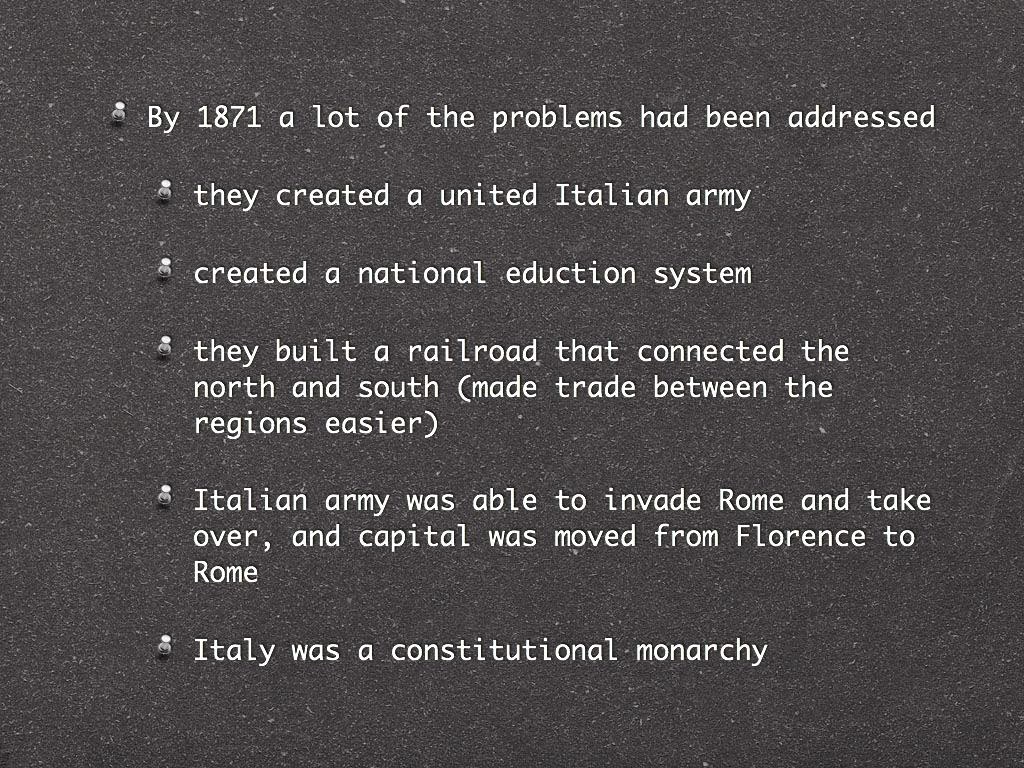
Nationalism as a Uniting Force

Below please find the slides on Italian Unification.  Take notes on these for homework.


Additionally, here are the notes on German Unification if you would like to review.


Monday, November 17, 2014

Three Estates Reading

Please read the following excerpt for homework (due 11/18/14).  As you read, please answer the questions that can be found at this link.

The Economic and Social Origins of the French Revolution of 1789

by Mithun Bhattacharya
This essay by Mithum Bhattacharya discusses the origins of the French Revolution. It is published on this site with his kind permission.

The French Revolution was one of the greatest socio-political upheavals of European and World history...

In order to understand the question of the social origins of the French Revolution closely, we need to study French society of 18th century. The whole social structure of l’ancien regime was divided into orders or ‘estates’. The First Estate comprised of the clergy... they owned about 1/10th of the land in France. The clergy enjoyed many privileges. In addition to the income derived as landowners from rents and feudal dues, they drew the ‘tithe’, which amounted to 1/12th of the yield from land. In return, however, they paid a very small percentage of their income to the king as ‘don gratuit’ or voluntary gifts. For our purpose of analysis, the clergy should be divided into different groups.

The Upper Clergy was drawn entirely from the ‘noblesse’ (nobility) and the relatively poor Lower Clergy were drawn from the ‘ronturier’ or the non-noble classes. There was no representation from the lower nobility to the upper clergy. This was deeply resented by the former, and in the course of the revolution, those dissatisfied with their lot joined the revolutionaries.

The Second Estate comprised the nobility, who like the clergy constituted a small fraction of the population... Traditional prejudice kept this class from indulging in productive activity. They served as councillors to the royalty, diplomats and governors. They enjoyed rights of local justice, village surveillance, monopoly over hunting and the maintenance of wells and wine presses. The most important differentiation between the nobles and the non-nobles was that the former enjoyed immunity from direct taxation in the form of ‘taille’ and various other taxes...

The Third Estate comprised the rest of France. At the head of this social group lay the bourgeoisie. At the head of the bourgeoisie were the ‘haute bourgeoisie’ or ‘grande bourgeoisie’, who were the great bourgeoisie of finance. They were a group of non-nobles, but not necessarily non-privileged people. They had risen into affluence by means of their hard work, frugality and commercial speculation. They began to ape (mimic) French nobility and were similar to them in many respects, except that they were not confirmed noble status...

Another important class in 18th century France, was the middle bourgeoisie or the professional classes, which included people like lawyers, doctors, teachers etc. There also existed the petty bourgeoisie, comprising of shopkeepers, artisans, small retail traders etc. Due to their standard of living, they were often clubbed together with the lower working groups. These groups constantly dreamed of attaining the noble status...

Below the bourgeoisie were the lower working classes, which included urban factory workers and peasants, even they cannot be labelled as of being a consolidated working class... The peasant class was also affected with internal contradictions that brought them together, and at the same time tore them apart. All kinds of dues were taken from them. The ‘taille’, the ‘capitaille’ and the ‘vingtieme’ absorbed 53% of their income, ecclestiacal titles 14% and other dues amounted to another 14%. Out of the remaining 19%, indirect taxes like the ‘gabelle’ or salt tax were also exacted...


References:
Georges Lefebvre (1957), The Coming Of The French Revolution
George Rude’ (1963), The Fontana History Of Europe: Revolutionary Europe
Alfred Cobban (1968), Aspects Of the French Revolution
Eric Hobsbawm (1975), The Age Of Revolution 1789-1848
Albert Soboul (1989), Understanding The French Revolution
Francois Furet (1981), Interpreting The French Revolution
William Doyle (1977), Origins Of The French Revolution
Alexis de Tocqueville (1955), The Old Regime and The French Revolution


Monday, October 27, 2014

Online Readings 10/29 and 10/31

Due on Wednesday, October 29th are questions regarding John Locke and Thomas Hobbes.  You can either write in complete sentences on a lined piece of paper, or you can print out the questions and answer directly on the sheet.

Due on Friday, October 31st are questions regarding Voltaire.  You can either write in complete sentences on a lined piece of paper, or you can print out the questions and answer directly on the sheet.

Monday, October 6, 2014

Oliver Cromwell Obit

Tuesday, October 7th, in class, you will be writing an obituary for Oliver Cromwell.  You will write it from a either a pro-Cromwell or an anti-Cromwell perspective.  You can think of this as practice for the longer English Revolution essay - writing a short paper that uses evidence to support one point.

The information for the in-class essay will be from our class discussion and the homework reading on Cromwell. 

As your assignment, please make a 2 column list.  On one side, list "positive" things that Oliver Cromwell did when in charge of England.  On the other, list "negative" things that Cromwell did.  Bullet points are fine.  This will be checked for a homework grade.

Friday, September 26, 2014

William Laud reading and questions

Please read the short background piece on William Laud, and answer the questions, which can be found here.  This assignment is due on Monday, September 29th.

Wednesday, September 3, 2014

Welcome to Modern European History!

So glad to have you in this class!  Please familiarize yourself with the course outline, expectations and rules so we can all be on the same page when we meet again on Friday.


Thursday, May 22, 2014

Monday, September 30, 2013

Civil War reading and questions

This homework is due on Wednesday, October 2nd.  Please do the reading on the English Civil War, and answer the questions found here.

Please note that you only need to read the first section of the online reading.

Monday, May 6, 2013

Monday, March 11, 2013

WWI Assignments

I will periodically update this page as you get more WWI assignments.

 Here are the links for:

the WWI syllabus

 the WWI project

 the Letter from a Trench homework assignment

the WWI project paper assignment (with website links)

the WWI Test Review Sheet 

Thursday, February 14, 2013

Scramble for Africa

Below are the various maps that we looked at for the Scramble for Africa exercise.  The short video clips are not embedded in the movie itself, but the links to youtube are below.


Additionally, here is the Scramble for Africa homework reading and questions again, in case you misplaced yours.

Monday, February 11, 2013

Scramble for Africa

Here is the homework due on Tuesday, February 12th and Thursday, February 14th.

The first two pages (and accompanying questions 1-7) are due on Tuesday.  The rest is due on Thursday.  I strongly recommend pacing yourself. 

Happy Reading!

Thursday, November 15, 2012

Online reading due 11/16

Please read this article that summarizes the significance of the Enlightenment era, and answer the questions found here.  You can either write in complete sentences on a lined piece of paper, or you can print out the questions and answer directly on the sheet.


Tuesday, September 25, 2012

Henry VIII and family

Here is the keynote presentation on Henry VIII and the creation of the Church of England.  Here are the points that make all this stuff so important, historically:

1.  Henry used Parliament to separate the Church of England from the Catholic Church (even though he didn't have to do that).

2.  Henry didn't really care about "religion" so much as he did his divorce.  Therefore he left it very unclear exactly what the religious practices of the Church of England were.

3.  He never solved the problem of a strong male heir, so the mess he left wasn't easily resolved.


Additionally, here's the homework assignment about Elizabeth.  The reading can be found online here, and the questions here.


Thursday, August 30, 2012